My town has had a series of delinquent events occurring since I have been here. Several fires have occurred in the early hours of the morning, burning down a political building, a house with a cane roof, and another home. There have been robberies of motos and batteries (expensive batteries that run the inversors, giving houses and businesses electricity when there is no electricity, which is often. Some say that the ‘mafia’ that runs the electricity in this country are also investors of such goods as these batteries, who have an economic interest to keep the electricity problem from improving). There is a lot of drug activity in my town, nothing which I see with my own eyes but hear about. Apparently a group of delinquents (drug users, dealers, robbers, this is a term used to encompass them all) meets after midnight at different locales, usually banquitas or gambling joints along the main road. The delinquency reached a high point a couple of weeks ago, when an 18 year old girl was violently murdered in the early morning, with the main suspect being her boyfriend who was supposedly deep into drugs, also a case of suspected domestic abuse. Nothing like this has happened before in the town. People die prematurely of motorcycle accidents by popping wheelies and doing tricks, racing, etc.- but never a murder like this.
The town has taken to meeting weekly to confront the problem. A town hall meeting was called last Saturday to see how they wanted to tackle the problem of delinquency. I could not make the meeting, but several community members filled me in. My neighbor told me this morning that the police rounded up suspected drug users the night. I told her that was great it should nip the problem right in the bud. She then informed me that after bribes to police officers and judges, they would be let free. She tells me a story about her brother. Basically one time her brother turned in youths that robbed his house, and they have since been released. Now they are threatening to kill him since he turned them in. He decided to no longer press charges for his own safety. She said that the town decided to take matters into their own hands, since the police wouldn’t do their job, and you cannot trust the authorities due to heavy corruption. How? Scare them by killing them. If they come into your house, don’t let them leave, deal with the problem yourself. Some people in the town believe they must resort to extreme measures, taking matters into their own hands to restore order- vigilantes. I countered with her that this is an extreme measure, that it is one thing to kill a person in self-defense but quite another to look them in the face and kill them to send a message to others. That is murder and a brutal crime. She counters that everyone in the town knows who the delinquents are, and no one says anything for fear. They do not turn them into the police because they don’t think anything good will come of it. The conversation ends with her telling me that they won’t exactly kill them themselves- no, no- they will HIRE someone else to do the dirty work, because there are people that do it for a living. Intense.
But this is one extreme view, as I learned of a more rational standpoint from a community leader. First, before taking matters into their own hands a la vigilantism, they are compiling a list of all the delinquents in town, a list that they will give to the police. That is where we are at as of now. He concluded by saying that if the police don’t do their job, the town will be forced to take matters into their own hands. To be continued...
Tuesday, March 30, 2010


Tuesday, March 16, 2010
A recap of 2010
As I approach my seven-month mark of being in the Dominican Republic on March 20th, my five-month mark of being in my town is approaching on the 30th.
A recap of 2010 thus far...... most of January I was scurrying to finish my organizational diagnostic, or rather I had been working on it for awhile so I was more struggling with trying to finish community interviews (a survey of 100 households in my community). I did about 2/3 of the interviews myself, with the other 1/3 completed with the help of the local youth church group as a part of the community service required while in high school. Interviews were a really good way to get to know different households in the community. At times they are also very humbling, grounding my over confidence and self perceived expertise in Spanish when I encounter a 90 something year old woman and have absolutely no idea what she is saying as she animatedly responds to my questions amidst an intermittent cackling laugh.
At the end of January I dropped all of my things at my new house and then headed early the next morning to the capital for 3 month in-service-training, which was held at a retreat-type convent right on the ocean in Santo Domingo (ironically surrounded by love motels with names like Si o No?). The whole Community Economic Development crew reunited for a week-long training session, filled with dinamicas (icebreakers- a Peace Corps favorite), helpful sessions, and two nights out playing miniature golf and seeing Avatar (the first movie I had been to in five months or so, must be a record for me). Everyone arrived with their project partners for the first two days.
In my case the treasurer came with me the first day to present the cooperative's organizational diagnostic, went home that night and then the President of the cooperative came the next day for a day of Project Planning. It was hard for me to get people to commit to coming to the training because I mainly work with women in the community whose primary job is being an ama de casa, or housewife. Spending the day away from the household is difficult, as they have to arrange for meals to be made, children/grandchildren to be taken care of and household duties to be covered by in-laws or neighbors. This took some adjusting on my part as far as understanding certain cultural differences and norms that I will be working within as a volunteer. The compromise was one member came the first day, then another the second, but no one could spend the night away from their houses because of compromisos (or commitments) in the house. For the third morning no one was there, which in the end was not a problem.
Since Christmas I would say one of my own personal milestones/bigger achievements has been moving into my own house. I had this milestone etched in my head when I began service, thinking only six months with host families and I’ll have my own space! I think that Peace Corps DR policy regarding volunteers living with host families is completely necessary, it gives you a full time crash course in culture, communication and integration into the community through trusted, well known members of the community (ideally, but some volunteers are not as lucky). Luckily my experience has been positive and I haven’t really had any complaints when it comes to the host families I was placed with. But it is a feat in itself adapting to a new culture, a new job as a volunteer, and not one, but three different host families in three different towns or cities before settling into your own place. To sum it up, it was a rollercoaster of ups, downs and in-betweens with a constant adjustment period. Finally I feel I am adjusted to the country, and my town is feeling more and more comfortable and I see many familiar (and many still unfamiliar) faces around.
It is nice and quiet in my new place, and of course at times a bit lonely. Luckily I have my dog to keep my company, even though he is a handful himself sometimes, burning bridges left and right. He’s banned from overnight stays at my old host families house (they also have 4 other dogs so five puts the Dona over the edge). Most recently, while I was in the capital for two days working, I asked the neighbor to give him food and water while I was gone, and left her with my keys. I came back to an exasperated woman who had to chase him around after he escaped from the backyard, who then fixed my back fence around the patio so he could no longer get out. Mind you this is after her and her husband helped me construct the fence around the patio so he would have somewhere to run instead of having to be tied to the fence. Add five amendments to the fence because Choco found some new way to Houdini himself out of the backyard, one case in which her husband had to chase him all the way to the police stop about two blocks away. So I will be exploring other options next time I need to leave my site! But Choco is definitely a crowd pleaser and quite a favorite with the kids in the neighborhood. When ever I am out walking without him they ask where he is—which is funny because I think they remember his name better than mine!
The house is wonderful. I have a nice view of the mountains, which are especially gorgeous in the crisp morning. It is a three-bedroom house so I have my bedroom (which I just painted a couple of walls a turquoise green color), a smaller room that will be my office, and a guest room. The Mother’s Center let me borrow a stove with an oven and some pots and pans- a huge expense spared. It already had a fridge, a bed for the spare room, and then my project partner loaned me a gas tank, a bed for my room and an armoire. After my essential fan, dishes and silverware and used washer purchases I have a solid base. Finally I have a table to eat and work on so I am set for now.
My little yellow house:

They say that to never be disappointed or deem anything as a failure you ought to go into things with no expectations. Well here in the DR, I feel that an entirely new definition is brought to the idea of NO EXPECTATIONS. Take the monopoly internet-phone service provider, Codetel (also in charge of the phone network Claro, all under a more commonly known little service provider, Verizon). There is no competition for Codetel here (at least in my area), therefore there is no need no compete to provide quality service to keep that customer coming back for more. The customer, unfortunately, HAS to come back for more. And thus there is no reason to provide excellent customer service but rather barely meet the customer’s needs because, well, the customer has to put up with it. I order a phone line in my house on a Friday, the technician will be at my house within 3-5 day period. The next Friday he calls in the morning, he will be in past 2 PM. Luckily I ask for a contact number just in case. I call him at 4 PM, are you lost? Technician: Uh, um, no well I am in Santo Domingo, I can’t make it out today. Me: And why didn’t you call me and let me know? When will you be coming? Technician: I will be there first thing in the morning, between 8:30 – 9 PM. Me: Ok, well come early because I have appointments in the afternoon. Come the next morning, I call at 10 PM to ask where the guy is. Technician: oh, I’m at my house, um Ill be there in an hour and a half. Of course I need to catch the Dominican translations to these clues. 8:30 in the morning, I can’t believe I believed that one! It really meant three hours later. Or rather they will make you wait a day without telling you and it is completely normal.
Guy finally comes and installs the phone. Doesn’t work. A week and a half later another guy comes, same process. But this time the guy does a good job and everything is set.
Another example, this time from the public sector. My project partner and I come to decision that it is time to call an all cooperative meeting. It will serve for two purposes, the first being to have a learning workshop help by the autonomous government institution that provides assistance for cooperatives. The second purpose is for me to open up the meeting with a presentation of my organizational diagnostic, a talk on project planning and management and to present the project that we will be working on for the next year and 8 months. Fifty invitations were sent out, it will be the first time the entire cooperative meets as a group, as they rarely meet (only the directive has met monthly since I have been here, the cooperative is at a stand still at the moment and picking back up now). The day before the event, the institution calls to cancel last minute- they won’t be able to make it. I mention expectations because my having no expectations, or certain low expectations was more limited to a) people showing up an hour late; b) maybe a third of people showing up. I guess I didn’t even think about whether or not the government agency was going to hold their appointment and their side of the bargain. But such is life here in the DR, you can’t really count on certain public services, the more obvious examples being electricity and water. (On a positive note, I must mention the institution has been extremely helpful otherwise- setting up an NGO meeting and providing some good resources!).
In the end a little under one third of the cooperative showed up, or 16 people. Thirteen of them were women that work in production, so I will be working with them more closely in the coming months. I can only look at it as a success in that I reached new people in the cooperative, presented my project and introduced myself to a couple of new faces, and talked about project planning. A second small success came right before this meeting at the monthly directive meeting, where we held a session to come up with the vision and the mission statements for the cooperative.
And a third success was a marmalade workshop. The sub Director of the PCDR came out to our campo with his wife two weeks ago to hold a small workshop on making marmalade using pectin. The marmalade product the women had been making was coming out much darker than it should, losing its color and flavor in the extended cooking process it took to make the marmalade. Pectin is a natural substance found mainly in citrus fruit that works as a gelling agent, reducing the cooking time to just minutes. Six women came to the workshop. We made mango marmalade and now have to work out the details of our own recipe. Now I am doing a cost-benefit analysis, looking into sources for glass bottles and pectin, which can both be quite expensive.
Women making mango marmalade:

Coming up soon are business classes for Construir tus suenos starting in April with youth in the community, continuing to implement the project for Fruticoop, Inc. and continuing to work with the women’s center Doll Workshop, or Taller de Munequeria. And soon my friend Mariange will be visiting from home—which I am very excited about!
A recap of 2010 thus far...... most of January I was scurrying to finish my organizational diagnostic, or rather I had been working on it for awhile so I was more struggling with trying to finish community interviews (a survey of 100 households in my community). I did about 2/3 of the interviews myself, with the other 1/3 completed with the help of the local youth church group as a part of the community service required while in high school. Interviews were a really good way to get to know different households in the community. At times they are also very humbling, grounding my over confidence and self perceived expertise in Spanish when I encounter a 90 something year old woman and have absolutely no idea what she is saying as she animatedly responds to my questions amidst an intermittent cackling laugh.
At the end of January I dropped all of my things at my new house and then headed early the next morning to the capital for 3 month in-service-training, which was held at a retreat-type convent right on the ocean in Santo Domingo (ironically surrounded by love motels with names like Si o No?). The whole Community Economic Development crew reunited for a week-long training session, filled with dinamicas (icebreakers- a Peace Corps favorite), helpful sessions, and two nights out playing miniature golf and seeing Avatar (the first movie I had been to in five months or so, must be a record for me). Everyone arrived with their project partners for the first two days.
In my case the treasurer came with me the first day to present the cooperative's organizational diagnostic, went home that night and then the President of the cooperative came the next day for a day of Project Planning. It was hard for me to get people to commit to coming to the training because I mainly work with women in the community whose primary job is being an ama de casa, or housewife. Spending the day away from the household is difficult, as they have to arrange for meals to be made, children/grandchildren to be taken care of and household duties to be covered by in-laws or neighbors. This took some adjusting on my part as far as understanding certain cultural differences and norms that I will be working within as a volunteer. The compromise was one member came the first day, then another the second, but no one could spend the night away from their houses because of compromisos (or commitments) in the house. For the third morning no one was there, which in the end was not a problem.
Since Christmas I would say one of my own personal milestones/bigger achievements has been moving into my own house. I had this milestone etched in my head when I began service, thinking only six months with host families and I’ll have my own space! I think that Peace Corps DR policy regarding volunteers living with host families is completely necessary, it gives you a full time crash course in culture, communication and integration into the community through trusted, well known members of the community (ideally, but some volunteers are not as lucky). Luckily my experience has been positive and I haven’t really had any complaints when it comes to the host families I was placed with. But it is a feat in itself adapting to a new culture, a new job as a volunteer, and not one, but three different host families in three different towns or cities before settling into your own place. To sum it up, it was a rollercoaster of ups, downs and in-betweens with a constant adjustment period. Finally I feel I am adjusted to the country, and my town is feeling more and more comfortable and I see many familiar (and many still unfamiliar) faces around.
It is nice and quiet in my new place, and of course at times a bit lonely. Luckily I have my dog to keep my company, even though he is a handful himself sometimes, burning bridges left and right. He’s banned from overnight stays at my old host families house (they also have 4 other dogs so five puts the Dona over the edge). Most recently, while I was in the capital for two days working, I asked the neighbor to give him food and water while I was gone, and left her with my keys. I came back to an exasperated woman who had to chase him around after he escaped from the backyard, who then fixed my back fence around the patio so he could no longer get out. Mind you this is after her and her husband helped me construct the fence around the patio so he would have somewhere to run instead of having to be tied to the fence. Add five amendments to the fence because Choco found some new way to Houdini himself out of the backyard, one case in which her husband had to chase him all the way to the police stop about two blocks away. So I will be exploring other options next time I need to leave my site! But Choco is definitely a crowd pleaser and quite a favorite with the kids in the neighborhood. When ever I am out walking without him they ask where he is—which is funny because I think they remember his name better than mine!
The house is wonderful. I have a nice view of the mountains, which are especially gorgeous in the crisp morning. It is a three-bedroom house so I have my bedroom (which I just painted a couple of walls a turquoise green color), a smaller room that will be my office, and a guest room. The Mother’s Center let me borrow a stove with an oven and some pots and pans- a huge expense spared. It already had a fridge, a bed for the spare room, and then my project partner loaned me a gas tank, a bed for my room and an armoire. After my essential fan, dishes and silverware and used washer purchases I have a solid base. Finally I have a table to eat and work on so I am set for now.
My little yellow house:

They say that to never be disappointed or deem anything as a failure you ought to go into things with no expectations. Well here in the DR, I feel that an entirely new definition is brought to the idea of NO EXPECTATIONS. Take the monopoly internet-phone service provider, Codetel (also in charge of the phone network Claro, all under a more commonly known little service provider, Verizon). There is no competition for Codetel here (at least in my area), therefore there is no need no compete to provide quality service to keep that customer coming back for more. The customer, unfortunately, HAS to come back for more. And thus there is no reason to provide excellent customer service but rather barely meet the customer’s needs because, well, the customer has to put up with it. I order a phone line in my house on a Friday, the technician will be at my house within 3-5 day period. The next Friday he calls in the morning, he will be in past 2 PM. Luckily I ask for a contact number just in case. I call him at 4 PM, are you lost? Technician: Uh, um, no well I am in Santo Domingo, I can’t make it out today. Me: And why didn’t you call me and let me know? When will you be coming? Technician: I will be there first thing in the morning, between 8:30 – 9 PM. Me: Ok, well come early because I have appointments in the afternoon. Come the next morning, I call at 10 PM to ask where the guy is. Technician: oh, I’m at my house, um Ill be there in an hour and a half. Of course I need to catch the Dominican translations to these clues. 8:30 in the morning, I can’t believe I believed that one! It really meant three hours later. Or rather they will make you wait a day without telling you and it is completely normal.
Guy finally comes and installs the phone. Doesn’t work. A week and a half later another guy comes, same process. But this time the guy does a good job and everything is set.
Another example, this time from the public sector. My project partner and I come to decision that it is time to call an all cooperative meeting. It will serve for two purposes, the first being to have a learning workshop help by the autonomous government institution that provides assistance for cooperatives. The second purpose is for me to open up the meeting with a presentation of my organizational diagnostic, a talk on project planning and management and to present the project that we will be working on for the next year and 8 months. Fifty invitations were sent out, it will be the first time the entire cooperative meets as a group, as they rarely meet (only the directive has met monthly since I have been here, the cooperative is at a stand still at the moment and picking back up now). The day before the event, the institution calls to cancel last minute- they won’t be able to make it. I mention expectations because my having no expectations, or certain low expectations was more limited to a) people showing up an hour late; b) maybe a third of people showing up. I guess I didn’t even think about whether or not the government agency was going to hold their appointment and their side of the bargain. But such is life here in the DR, you can’t really count on certain public services, the more obvious examples being electricity and water. (On a positive note, I must mention the institution has been extremely helpful otherwise- setting up an NGO meeting and providing some good resources!).
In the end a little under one third of the cooperative showed up, or 16 people. Thirteen of them were women that work in production, so I will be working with them more closely in the coming months. I can only look at it as a success in that I reached new people in the cooperative, presented my project and introduced myself to a couple of new faces, and talked about project planning. A second small success came right before this meeting at the monthly directive meeting, where we held a session to come up with the vision and the mission statements for the cooperative.
And a third success was a marmalade workshop. The sub Director of the PCDR came out to our campo with his wife two weeks ago to hold a small workshop on making marmalade using pectin. The marmalade product the women had been making was coming out much darker than it should, losing its color and flavor in the extended cooking process it took to make the marmalade. Pectin is a natural substance found mainly in citrus fruit that works as a gelling agent, reducing the cooking time to just minutes. Six women came to the workshop. We made mango marmalade and now have to work out the details of our own recipe. Now I am doing a cost-benefit analysis, looking into sources for glass bottles and pectin, which can both be quite expensive.
Women making mango marmalade:

Coming up soon are business classes for Construir tus suenos starting in April with youth in the community, continuing to implement the project for Fruticoop, Inc. and continuing to work with the women’s center Doll Workshop, or Taller de Munequeria. And soon my friend Mariange will be visiting from home—which I am very excited about!
Tuesday, January 5, 2010
Holidays in the DR
Holidays in my site…
December is a sleepy month in the DR. The first half of the month was filled with the last meetings of various community groups, wrapping up the year with Angelitos (secret santa), eating the Dulces de Navididad (Christmas sweets of apples, raisins and gumdrops), dancing to bachata and merengue and perico ripiao (very fast version of merengue), and playing a game called El Secreto.

Dulces de Navidad
El Secreto, or the Secret, is a game with many different versions played at parties. Version 1: Wrap a present and attach a chain link of paper to it, with each paper containing a sentence. A person begins, opening the paper that contains a sentence such as: he who is the biggest flirt, the girl with the lightest eyes, the cutest, and the most voluptuous. It really depends on the party and the crowd at how tame the sentences will be. The person reading it chooses the person in the room they think fits that description, and gives them a kiss, usually on the cheek. The game continues until the chain is gone and the last person opens the present. Version two: Put papers in balloon. A boy takes the balloon and a girl comes up and they pop the balloon using their bodies (usually sitting on the lap works best). They read the strip of paper in the balloon and game continues as such.
As food is an integral part of Dominican culture, there are many, many big late night meals with your bowl/plate filled to the brim with amazingly tasty Dominican cuisine (to give you an idea: spaghetti, moro- beans and rice mixed, yucca, guineo or banana served in more ways than you can imagine, plátano maduro frito or fried ripe plantain, guandules- green beans with the beans stripped out and normally cooked with coconut, bread, chicken and pork, goat, Russian salad, potato salad, stewed eggplant, okra, don’t get me started on deserts, etc.).
There is also the aguinardo (caroling a la DR), where groups of people start at one house and begin singing and dancing in the early morning hours, moving from house to house, waking people up that then join the group. The crowd grows as they move through the community.
Christmas is not as big of a deal as is Christmas Eve. Christmas Eve is largely centered on the three F’s- family, food and fun. Preparation for the big Christmas Eve meal often begins the day before, and continues the entire next day. The food is set out and the massive food consumption begins. Many people pass through, sharing the meal and wishing each other a Feliz Noche Buena (Merry Christmas Eve). Some people pass through singing Christmas songs. This continues until very late (12/1 or even later) with music, dancing, and Presidente beer if one so desires.
Caroling (aguniardo) a la DR:

Host parents' daughter, Yamile with excellent food she prepared:

host parents dancing:

Unlike American culture, or at least in my experience Christmas presents are not exchanged. Santa doesn’t pass through the DR or much of Latin America from what I understand. Presents are instead given to children on January 6, Dia de los Reyes Magros, which the government changed to the 4th this year because it fell on a Monday and a four- day weekend just wasn’t long enough. Christmas day is a quite and relaxing day where people eat leftovers from Christmas Eve. It was not easy being away from family this year, and although I was quite distracted on Christmas Eve with all the festivities, Christmas Day held more somber tone for me. Luckily, some family friends were heading to the beach and invited Choco and me to come along. We stopped by Los Corbanitos, which is a remote and beautiful beach that happens to be the closest to my town (5 Km away). Then we continued on to spend some time at Punto Salinas.

Me and Choco at Los Corbanitos
Christmas Party in the Capital…
A week before Christmas I was also in the capital going to go the Director’s annual Christmas party, held on the top floor of an apartment building that has an amazing view of Santo Domingo and the ocean. We enjoyed some Chinese food and an amazing array of deserts, and some hanging out time. I was asked to attend an event in Azua, a town thirty minutes past Bani to go to a conference hosted by the Secretary of the Environment (with Jaime David, former Vice-president and now Secretary of Environment) at an off the road beach. Accompanied by three other volunteers and a Peace Corps driver, we finally found the event after much searching, which was to support a sort of local shrimping project sponsored by the Taiwanese government and the Dominican government.
Outside Azua:

The beach was quite nice and the day interesting in so many words, with a flat tire on the way home and a nauseous bus passenger who projectile vomited a hot pink substance all over the cobrador (fare taker) and me on the bus ride on the way back to my town from Bani. Good times.
The New Year….
Two thousand ten a new year and new decade has commenced. Just to think ten short years ago we were all huddled up in our basements with can openers and stacks of bottled water awaiting the impending doom of Y2K (although I was probably dancing to electronic music in some warehouse)! This new years I brought in 2010 in Caberete with some great PCV friends and also my friend Julieta who happened to be around to celebrate!
Caberete is a beautiful beach town east of Puerto Plata. From Puerto Plata (roughly 3 ½ hours north of Santo Domingo) continue onto Sosúa, the sex tourism capital of the DR, and take a taxi twenty minutes east to Caberete, a once sleepy surfing town turned tourism and water sports destination. We lucked out on weather really, with the day time being mainly clear to enjoy the gorgeous beach, warm water, and waves fit for challenging body surfing. We had a nice place with a kitchen and beds for everyone on a place right on the beach. Caberete is nice because everywhere seems to be pretty much on the beach, with the main road running along the beach and nearly everything accessible to the beach. There are a lot of nice beach side places to eat and beach side bars for afternoon/night time. Accommodations are inexpensive compared to other touristy places. It was a great time and I could not have asked for better food, company, fun and beach time. After new years we had a quick stop in Rio San Juan, a beautiful quiet neighbor of Cabarete with hotels on the cliffs of the ocean and beautiful picturesque beaches just a 10 minutes bus ride away. Gorgeous and I will definitely be going back.
Cabarete:

Playa Grande, Near Rio San Juan:

My trip up north was just what I needed to start of the New Year running with a very work filled January. Being back in my site feels better than what I expected. I have already began chipping away at the mountain of community interviews I have to conduct for my survey, the breadth of the work I have to complete in preparation for 3 month IST (in service training held for one week in the capital).
Host mom phone outside house:

Choco sleeping:

December is a sleepy month in the DR. The first half of the month was filled with the last meetings of various community groups, wrapping up the year with Angelitos (secret santa), eating the Dulces de Navididad (Christmas sweets of apples, raisins and gumdrops), dancing to bachata and merengue and perico ripiao (very fast version of merengue), and playing a game called El Secreto.

Dulces de Navidad
El Secreto, or the Secret, is a game with many different versions played at parties. Version 1: Wrap a present and attach a chain link of paper to it, with each paper containing a sentence. A person begins, opening the paper that contains a sentence such as: he who is the biggest flirt, the girl with the lightest eyes, the cutest, and the most voluptuous. It really depends on the party and the crowd at how tame the sentences will be. The person reading it chooses the person in the room they think fits that description, and gives them a kiss, usually on the cheek. The game continues until the chain is gone and the last person opens the present. Version two: Put papers in balloon. A boy takes the balloon and a girl comes up and they pop the balloon using their bodies (usually sitting on the lap works best). They read the strip of paper in the balloon and game continues as such.
As food is an integral part of Dominican culture, there are many, many big late night meals with your bowl/plate filled to the brim with amazingly tasty Dominican cuisine (to give you an idea: spaghetti, moro- beans and rice mixed, yucca, guineo or banana served in more ways than you can imagine, plátano maduro frito or fried ripe plantain, guandules- green beans with the beans stripped out and normally cooked with coconut, bread, chicken and pork, goat, Russian salad, potato salad, stewed eggplant, okra, don’t get me started on deserts, etc.).
There is also the aguinardo (caroling a la DR), where groups of people start at one house and begin singing and dancing in the early morning hours, moving from house to house, waking people up that then join the group. The crowd grows as they move through the community.
Christmas is not as big of a deal as is Christmas Eve. Christmas Eve is largely centered on the three F’s- family, food and fun. Preparation for the big Christmas Eve meal often begins the day before, and continues the entire next day. The food is set out and the massive food consumption begins. Many people pass through, sharing the meal and wishing each other a Feliz Noche Buena (Merry Christmas Eve). Some people pass through singing Christmas songs. This continues until very late (12/1 or even later) with music, dancing, and Presidente beer if one so desires.
Caroling (aguniardo) a la DR:

Host parents' daughter, Yamile with excellent food she prepared:

host parents dancing:

Unlike American culture, or at least in my experience Christmas presents are not exchanged. Santa doesn’t pass through the DR or much of Latin America from what I understand. Presents are instead given to children on January 6, Dia de los Reyes Magros, which the government changed to the 4th this year because it fell on a Monday and a four- day weekend just wasn’t long enough. Christmas day is a quite and relaxing day where people eat leftovers from Christmas Eve. It was not easy being away from family this year, and although I was quite distracted on Christmas Eve with all the festivities, Christmas Day held more somber tone for me. Luckily, some family friends were heading to the beach and invited Choco and me to come along. We stopped by Los Corbanitos, which is a remote and beautiful beach that happens to be the closest to my town (5 Km away). Then we continued on to spend some time at Punto Salinas.

Me and Choco at Los Corbanitos
Christmas Party in the Capital…
A week before Christmas I was also in the capital going to go the Director’s annual Christmas party, held on the top floor of an apartment building that has an amazing view of Santo Domingo and the ocean. We enjoyed some Chinese food and an amazing array of deserts, and some hanging out time. I was asked to attend an event in Azua, a town thirty minutes past Bani to go to a conference hosted by the Secretary of the Environment (with Jaime David, former Vice-president and now Secretary of Environment) at an off the road beach. Accompanied by three other volunteers and a Peace Corps driver, we finally found the event after much searching, which was to support a sort of local shrimping project sponsored by the Taiwanese government and the Dominican government.
Outside Azua:

The beach was quite nice and the day interesting in so many words, with a flat tire on the way home and a nauseous bus passenger who projectile vomited a hot pink substance all over the cobrador (fare taker) and me on the bus ride on the way back to my town from Bani. Good times.
The New Year….
Two thousand ten a new year and new decade has commenced. Just to think ten short years ago we were all huddled up in our basements with can openers and stacks of bottled water awaiting the impending doom of Y2K (although I was probably dancing to electronic music in some warehouse)! This new years I brought in 2010 in Caberete with some great PCV friends and also my friend Julieta who happened to be around to celebrate!
Caberete is a beautiful beach town east of Puerto Plata. From Puerto Plata (roughly 3 ½ hours north of Santo Domingo) continue onto Sosúa, the sex tourism capital of the DR, and take a taxi twenty minutes east to Caberete, a once sleepy surfing town turned tourism and water sports destination. We lucked out on weather really, with the day time being mainly clear to enjoy the gorgeous beach, warm water, and waves fit for challenging body surfing. We had a nice place with a kitchen and beds for everyone on a place right on the beach. Caberete is nice because everywhere seems to be pretty much on the beach, with the main road running along the beach and nearly everything accessible to the beach. There are a lot of nice beach side places to eat and beach side bars for afternoon/night time. Accommodations are inexpensive compared to other touristy places. It was a great time and I could not have asked for better food, company, fun and beach time. After new years we had a quick stop in Rio San Juan, a beautiful quiet neighbor of Cabarete with hotels on the cliffs of the ocean and beautiful picturesque beaches just a 10 minutes bus ride away. Gorgeous and I will definitely be going back.
Cabarete:

Playa Grande, Near Rio San Juan:

My trip up north was just what I needed to start of the New Year running with a very work filled January. Being back in my site feels better than what I expected. I have already began chipping away at the mountain of community interviews I have to conduct for my survey, the breadth of the work I have to complete in preparation for 3 month IST (in service training held for one week in the capital).
Host mom phone outside house:

Choco sleeping:

Friday, December 4, 2009
My first month in site and a funny story
I have been in my site for over a month now. Things are starting to fall into place a little more each day, although readjusting back at my site after three fun filled pseudo debaucherous days in the capital proved more difficult than I thought it would.
So what exactly have I been up to?
I have been working on my community and organizational diagnostics, and getting to know my community. The first three months of Peace Corps service are a diagnostic phase. As a community economic volunteer you complete two diagnostics: the community diagnostic and the organizational diagnostic in order to form needs assessments for both and to design your projects. Part of the community diagnostic is a community map, where you walk around recording streets, houses, churches, identifying small business and resources for the community (example: where the water comes from; public transportation, etc.).
I started the community map about a week after being here, which I am about ¾ done with at this point. The town, which is a Municipal District already had a map of the streets from the early 90’s when they paved the majority of the roads. I got a copy from the local ayuntamiento (city hall) and it proved useful in navigating and adding houses, new streets that aren’t on the map and filling in the 100 plus micro, small and medium sized business in the town. Walking around I have been meeting a lot of people that don't live in my area but in one of the five other sections, talking to kids, business owners, sitting with residents in plastic chairs under the shade of trees in the street in the early afternoons, to compartir (share) and gain confianza (trust) with the members of the community.
Just getting my face out there and getting to be known is good, even though the crazy and bewildered looks are a bit draining sometimes (although less frequent). Sometimes it is overwhelming, with so many new people that I can hardly keep track of whom I’ve met, who is related to whom, and who is a member of which group(s). Although a town of 6000 seems small and tangible enough, it is a lot at times to be one person trying to remember so many people. I keep reminding myself that it will take time to integrate, and after a month I finally feel like things are slowly beginning to fall into place.
I am just beginning to interview households in order to conduct survey of the community with the help of the local church youth group. With this I can gather basic info on the community, identify needs and potential projects to work on with the community while I am here.
As my town is very organized, I have been going to many community group meetings. I sit in on many, many conversations involving a lack of water in this dry region that has barely received any rainfall yet this year, affecting the crops, business and life in general. They are working diligently to get wells working to extract water down below the dry river bed of the Rio Ocoa, but are waiting for government agencies to provide the much needed equipment and resources necessary to get all of them to function. Daily conversations consist of farming and local crops, which I expect to be an expert in by the time I leave (mainly mango, onion, papaya, plantain and banana).
I also hear a lot of chisme (gossip) about people who I’m not yet familiar with being so new, so it’s hard to follow (so and so from such and such town who is related to Fulana who blah blah blah with Fulano).
And of course, I go to the beach with my family. I’ve been to the two busier points nearby- Palmar de Ocoa (8 km) and Punto Salinas (Not many kilometers, but more than 8):

(Salt mines at Punto Salinas)

(Boats at Palmar de Ocoa)
Now I am about ¾ done with my organizational diagnostic, which analyzes many areas of an organization in addition to a SWOT (Strengths, Weaknesses, Opportunities and Threats) Analysis. In the first week of February the CED volunteers in my training group will come together at the 3-month IST (in-service-training) with our project partners to present the diagnostic and then begin project planning.
My cooperative, Fruticoop, Inc., which produces dried fruit and mango marmalade using solar technology has a wonderful product but has accrued losses in the past several years due to lack of commercialization and sales of their products under the brand FrutiSol. I hope to help promote and sell the product, assist in the internal organization and improving some of the production problems that the currently have, and the quality control of the product as well.
My project partner, also the president of the Cooperative is very motivated, and we have been meeting a lot. Tomorrow I will be going back to Santo Domingo to meet with the directors of the Foundation for Agriculture and the Environment (FAMA, a national NGO that initiated and managed many projects within Fruticoop, inc. since it’s beginnings in 2003/4) to discuss the collaboration between the two and see the organic market they have every Friday where they sell our products and also produce from local farmers.
That is my work/personal life in a nutshell. In addition I read, a lot. I sleep and enjoy my afternoon nap. I watch puppies and roosters and palm trees in the hot sun and ponder buying a hammock. And I talk to other volunteers and people from back home about it all, the good and bad. I motivate myself to do work and as soon as I do I realize how much there is to do and while living here there will is no shortage of opportunities for projects and willing parties to take on new projects.
And to wrap up this obnoxiously long blog entry, I have funny misunderstandings- even though I feel comfortable with Spanish and feel like I am improving all the time. And the story goes that one morning a couple of weeks ago my Dona comes in and tells me that one of the dogs, Lila, has a garrapata. I did not know this word yet so I ask what a garrapata is. She says, oh es un pajarito que chupa la sangre (Literal translation- It is a little blood sucking bird). Having just woken up and still deep in slumber I forget that the word pajarito is also used to describe insects and bugs. So I start imagining this crazy big bird sucking on the dog Lila’s blood, and start wondering if Lila is going to die or is dead, or what this crazy bird is that I have never heard of. After this goes on for awhile (way longer than it should have) I finally realize that garrapata is the word for tick.
So what exactly have I been up to?
I have been working on my community and organizational diagnostics, and getting to know my community. The first three months of Peace Corps service are a diagnostic phase. As a community economic volunteer you complete two diagnostics: the community diagnostic and the organizational diagnostic in order to form needs assessments for both and to design your projects. Part of the community diagnostic is a community map, where you walk around recording streets, houses, churches, identifying small business and resources for the community (example: where the water comes from; public transportation, etc.).
I started the community map about a week after being here, which I am about ¾ done with at this point. The town, which is a Municipal District already had a map of the streets from the early 90’s when they paved the majority of the roads. I got a copy from the local ayuntamiento (city hall) and it proved useful in navigating and adding houses, new streets that aren’t on the map and filling in the 100 plus micro, small and medium sized business in the town. Walking around I have been meeting a lot of people that don't live in my area but in one of the five other sections, talking to kids, business owners, sitting with residents in plastic chairs under the shade of trees in the street in the early afternoons, to compartir (share) and gain confianza (trust) with the members of the community.
Just getting my face out there and getting to be known is good, even though the crazy and bewildered looks are a bit draining sometimes (although less frequent). Sometimes it is overwhelming, with so many new people that I can hardly keep track of whom I’ve met, who is related to whom, and who is a member of which group(s). Although a town of 6000 seems small and tangible enough, it is a lot at times to be one person trying to remember so many people. I keep reminding myself that it will take time to integrate, and after a month I finally feel like things are slowly beginning to fall into place.
I am just beginning to interview households in order to conduct survey of the community with the help of the local church youth group. With this I can gather basic info on the community, identify needs and potential projects to work on with the community while I am here.
As my town is very organized, I have been going to many community group meetings. I sit in on many, many conversations involving a lack of water in this dry region that has barely received any rainfall yet this year, affecting the crops, business and life in general. They are working diligently to get wells working to extract water down below the dry river bed of the Rio Ocoa, but are waiting for government agencies to provide the much needed equipment and resources necessary to get all of them to function. Daily conversations consist of farming and local crops, which I expect to be an expert in by the time I leave (mainly mango, onion, papaya, plantain and banana).
I also hear a lot of chisme (gossip) about people who I’m not yet familiar with being so new, so it’s hard to follow (so and so from such and such town who is related to Fulana who blah blah blah with Fulano).
And of course, I go to the beach with my family. I’ve been to the two busier points nearby- Palmar de Ocoa (8 km) and Punto Salinas (Not many kilometers, but more than 8):


(Boats at Palmar de Ocoa)
Now I am about ¾ done with my organizational diagnostic, which analyzes many areas of an organization in addition to a SWOT (Strengths, Weaknesses, Opportunities and Threats) Analysis. In the first week of February the CED volunteers in my training group will come together at the 3-month IST (in-service-training) with our project partners to present the diagnostic and then begin project planning.
My cooperative, Fruticoop, Inc., which produces dried fruit and mango marmalade using solar technology has a wonderful product but has accrued losses in the past several years due to lack of commercialization and sales of their products under the brand FrutiSol. I hope to help promote and sell the product, assist in the internal organization and improving some of the production problems that the currently have, and the quality control of the product as well.
My project partner, also the president of the Cooperative is very motivated, and we have been meeting a lot. Tomorrow I will be going back to Santo Domingo to meet with the directors of the Foundation for Agriculture and the Environment (FAMA, a national NGO that initiated and managed many projects within Fruticoop, inc. since it’s beginnings in 2003/4) to discuss the collaboration between the two and see the organic market they have every Friday where they sell our products and also produce from local farmers.
That is my work/personal life in a nutshell. In addition I read, a lot. I sleep and enjoy my afternoon nap. I watch puppies and roosters and palm trees in the hot sun and ponder buying a hammock. And I talk to other volunteers and people from back home about it all, the good and bad. I motivate myself to do work and as soon as I do I realize how much there is to do and while living here there will is no shortage of opportunities for projects and willing parties to take on new projects.
And to wrap up this obnoxiously long blog entry, I have funny misunderstandings- even though I feel comfortable with Spanish and feel like I am improving all the time. And the story goes that one morning a couple of weeks ago my Dona comes in and tells me that one of the dogs, Lila, has a garrapata. I did not know this word yet so I ask what a garrapata is. She says, oh es un pajarito que chupa la sangre (Literal translation- It is a little blood sucking bird). Having just woken up and still deep in slumber I forget that the word pajarito is also used to describe insects and bugs. So I start imagining this crazy big bird sucking on the dog Lila’s blood, and start wondering if Lila is going to die or is dead, or what this crazy bird is that I have never heard of. After this goes on for awhile (way longer than it should have) I finally realize that garrapata is the word for tick.
Dia de Pavo – Thanksgiving in Santo Domingo
From there I went to the vet with a couple of other volunteers to adopt my adorable new puppy! The cachorro (puppy) is the only little boy out of six from a batch of puppies that another volunteer had been raising at her site in Samaná, then brought them all back to Santo Domingo, where they were adopted by other volunteers. He is about seven weeks old, brown (looks kind of like a chocolate lab) and his name is Choco “Don’t call me Viralata” Late (Viralata is the word here for street dog, named for dogs knocking over trash cans). I was going to go with Hank, but that doesn’t exactly translate well into Spanish, and then it would be something like Eris (what people sometimes call me) y Ank (the H doesn’t really get pronounced), so you can see why I decided against it.
(Choco at home)

That night we had a dance party on the second floor of the hotel where most of the youth volunteers were staying after a healthy dinner of comida criollo china (Chinese and fried food joints scattered around the island). The next day was the Thanksgiving extravaganza at a country club near the Botanical Gardens in Santo Domingo. Lots of pool time, excellent brunch with your T-day dinner staples of Turkey, stuffing, pumpkin and pecan pie, mashed potatoes and a new personal favorite, sweet mashed potatoes. Followed by some more poolside fun, a talent show and then out in Santo Domingo to some places that reminded me those I used to frequent in Barcelona while studying abroad.
And by Saturday morning I was back my site with the puppy, getting back into the campo life. Now at the house we have two dogs, and four puppies. As my Dona says my dog is still pegado a la teta (stuck to the teet) because he keeps trying to feed off of the Mom that is feeding her puppies that are about a third his size. The photo explains it all:
(Mamando con los otros cachorros)

Saturday, October 31, 2009
Project Partner Day and First Site Visit
I finally got my site and have already gone for a visit. I am living in a small pueblo of about 6000 people southwest of Santo Domingo, about 30 minutes southwest of Bani. I am right near the sand dunes that are famous in the Caribbean, a few nice beaches within a short motoconcho or guagua rides reach. It is semi arid desert weather, with lower humidity than Santo Domingo (gracias a Dios) and temperatures usually in the 90s right about now. It is pretty much summer all year round and doesn't rain much. Since it is fall I am coming into their cool season, which is still hot.
Before you permanently move into your project site, trainees go for a five day site visit. It begins with the madness that is project partner day, where we meet our project partners who we will be working with the next two years. After working with them in the morning and having lunch, everyone departs to their respective sites and brings as much of their belongings as possible to make for an easier trip on the permanent move on Friday the 30th. We lugged all of our stuff to Entrena, hopped on buses over to San Pablo where the day happens (this was the same convent we had all spent our first night in the DR two and a half months earlier). I met my two project partners, a man and a women who were both very nice, good first impression. The woman is a member of the cooperative that produces dried fruit (my actual project partner is the president of the cooperative, but she couldn't make it), and the man is a member of the local development association.
Shortly following lunch we set out to my site. First we made a quick stop at FAMA in Santo Domingo, a local NGO that supports sustainable development projects in my site and around the DR. We met with the staff and then headed southwest on the highway.
We finally get there (ok, it is close only a little over two hours) and I am pretty surprised at how nice the town is. Little tree lines streets with sidewalks and paved roads throughout most of the town- notably clean. Some areas are more marginalized and poorer than others, not all roads are paved but nearly all and there are about six parts of town. There is also a Haitian community here so I look forward to Creole training in the spring to integrate with the entire community.

My host parents are in their early seventies, and their granddaughter in her twenties lives there as well. My host dad is the president of the development association and the granddaughter is the secretary. Also there is a parrot that whips out phrases in Spanish asking the important philisophical questions like hay platano? I get a special gold medal if I can teach the parrot my name, since Erin usually becomes Eris here (parrot in the photo, chilling in its tree in our backyard). There are also a couple of shaggy dogs, a couple of roosters, a cat and her kitten (standoffish but it will come around) and some other birds. The little shaggy white dog is pregnant so I may be getting a puppy very soon.
Back yard at my new house.

My house is nice, there is a normal bathroom and shower, fan in room, nicest place Ive lived out so far. So its comfy. And there are three cooperatives: two mango cooperatives that sell mangoes domestically and export, and a cooperative that produces dried fruit using a solar powered drier. The dried fruit cooperative is my main project and is mainly comprised of women, with some male members. My other project partner works in the local development association (the president is also my host dad) which is down the street from my house. There seem to be a lot of motivated people that I met at the various community group meetings I went to throughout the week, and a lot of opportunities to work with the community.
Below: View of the Caribbean from a church down the street from my house.

The town has the local hospital for the region, highschool, primary school, two baseball fields, a central square, and lots of small businesses (little clothing stores, colmados, colmadons, ferreterias, auto repairs shops, paint shops, cafeterias, etc). There have been a lot of development projects over the years due to some very active a forward thinking community associations and residents, and remittance money being reinvested from the large Diaspora living mainly in the Bronx (also Boston and Florida). Every household seems to have half of their family in the little DR, aka the Bronx.

The town also has trash collection and organic trash collection that they have a large organic compost, where they make fertilizer and sell it. Basically Ill be learning a lot and working with some sustainable development projects. (See photo at left, the Planta Abono Organico or Compost and my host dad).
So my first impression is good and I am excited to go back next weekend and get started. We swear in as volunteers on Wednesday, and will offically start our two years then. Made it through training and now the real work begins!!
Before you permanently move into your project site, trainees go for a five day site visit. It begins with the madness that is project partner day, where we meet our project partners who we will be working with the next two years. After working with them in the morning and having lunch, everyone departs to their respective sites and brings as much of their belongings as possible to make for an easier trip on the permanent move on Friday the 30th. We lugged all of our stuff to Entrena, hopped on buses over to San Pablo where the day happens (this was the same convent we had all spent our first night in the DR two and a half months earlier). I met my two project partners, a man and a women who were both very nice, good first impression. The woman is a member of the cooperative that produces dried fruit (my actual project partner is the president of the cooperative, but she couldn't make it), and the man is a member of the local development association.
Shortly following lunch we set out to my site. First we made a quick stop at FAMA in Santo Domingo, a local NGO that supports sustainable development projects in my site and around the DR. We met with the staff and then headed southwest on the highway.
We finally get there (ok, it is close only a little over two hours) and I am pretty surprised at how nice the town is. Little tree lines streets with sidewalks and paved roads throughout most of the town- notably clean. Some areas are more marginalized and poorer than others, not all roads are paved but nearly all and there are about six parts of town. There is also a Haitian community here so I look forward to Creole training in the spring to integrate with the entire community.

Back yard at my new house.

Below: View of the Caribbean from a church down the street from my house.


The town also has trash collection and organic trash collection that they have a large organic compost, where they make fertilizer and sell it. Basically Ill be learning a lot and working with some sustainable development projects. (See photo at left, the Planta Abono Organico or Compost and my host dad).
So my first impression is good and I am excited to go back next weekend and get started. We swear in as volunteers on Wednesday, and will offically start our two years then. Made it through training and now the real work begins!!
Monday, October 5, 2009
Living in the Campo and shortly returning to Pantoja
We have been in the campo for almost three weeks now, and have about a week and a half left here before we head back to Santo Domingo for the Business Plan competition (something that Community Economic Development Sector works with' volunteers work with youth to form business plans, and the winners of the competition are given seed money to start their business).

Campo life is definitely very relaxing, and I enjoy my outdoor shower under the stars, or in the plain daylight dumping refreshing cool buckets of water on my head while looking up at my avocado and cherry trees. (Photo at left: in my favorite avocado tree next to my house). It is nice to get to know the community more because it is that much more tangible because it is smaller. The volunteers are spread out between four different communities, so we all come together for technical training and the occasional get together.
Two of the more recent eco tour sights included a trip to 27 charchos, beautiful waterfalls near our sites that boast 27 pools of water beneath a canopy of trees. We hiked only half of them in the interest
of saving some time and cash since we had to get back before the afternoon to go to community meetings. We went equipped with helmuts and life jackets and fun guides with interesting animal calling talents that jumped out at us from randomn spots in the bushes. My ego definately came down a few notches after being tricked way more than once. But the water was beautiful, we for the most part all made it off of even the larget charcos, and enjoyed swimming in the cool blue-green waters underneath the trees in stone water ways, sliding in some parts through rocks that were crafted into natural water slides falling into pools.
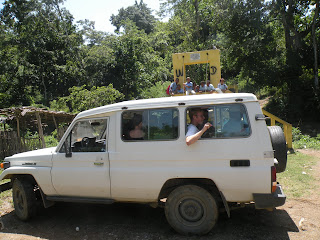
Below: The jeep we roll 20 deep in...
 The second of our ecotourism trips was, well, interesting. What was supposed to be a three hour round trip hike turned into a bushwacking extravaganza up the face of a mountain and back around the other side to the much anticipated water falls, the source of the 27 charcos and was supposedly well worth it. After hiking up the front of the mountain to a dry pool at the top (where I think the guides thought the pools were, but they were actually way on the other side), we scaled back down and went right up the face of the mountain to the top in order to hike down the other side to find the what seemed to be imaginary pools. We made it up eventually but were at times quite frustrated beacuse we ran out of water and didnt anticipate such a trek nor were we prepared for it at all. We hiked down the other side to a trickling pool and filled up our water bottles with fresh spring water. Good thing because on my way back up a few of us ended up having to drink the water (I had to have water) but took anti-parasitic medication after we got back. But in the end it was worth it with a beautiful view from the top and a wealth of experience, plus we had a good group experience to tell the others. I definitely will be asking more questions beforehand next time around.
This past weekend members of the Junta de Vecinos and all of us living in Los Claveles went to the beach in Puerto Plata to take in the sun. It was beautiful and right on the beach, one of the days that truly reminds me that I live in the Caribbean, except for the fact that I am sweating in October. And since it took us four hours to go in a big group to get there, when it was only 45 minutes away, I was also reminded I live in the DR. The beach itself was amazing, with crystal blue waters stretching out for miles, palm trees and white sands stretching on either side as far as you can see. And the water was relatively shallow and calm. I am getting used to the fact that I have to wear my tank top and shorts in the water, since I was around the community (although I prefer the bikini, what can I say). But it was also a tourist beach, so it wasn´t a huge deal if you were in a bikini, but it is definitely weird for Dominicans, who like to cover up while swimming.
The way to and from the beach was crazy and wild. We were piled eleven in a minivan while the rest of the people were piled in an old school bus. The entire way there the two drivers enjoyed a fun game of chicken, darting in front of oncoming traffic to cut in front of each other. My life flashed before my eyes several times but I wasn´t about to get around in walk soooo, I hung on for the ride. Most of the drivers here are pretty crazy and questionable two lane roads are often three lane roads with the middle (and the other lanes) used for passing no matter if you are in a blind turn, hill, or whatever. I guess I am not that disappointed that we don´t get to drive here!

Besides all that, lots of technical training and I have become surprisingly accustomed to certain aspects of campo life. For example large spiders in my bed, effective latrine use and flicking off ´pajaritos¨, which literally means little birds but it is the word used for insects. I often get laughed at for dodging the pajaritos and ¨mariposas¨(Literally a butterfly, but no this also means big moths), but all in good fun.
So far it has been fun, ups downs, we are all getting closer and I am especially excited to see all the other groups of volunteers when we reunite in Pantoja in the coming weeks!!
Photo above: Ladies of Los Claveles

Two of the more recent eco tour sights included a trip to 27 charchos, beautiful waterfalls near our sites that boast 27 pools of water beneath a canopy of trees. We hiked only half of them in the interest
of saving some time and cash since we had to get back before the afternoon to go to community meetings. We went equipped with helmuts and life jackets and fun guides with interesting animal calling talents that jumped out at us from randomn spots in the bushes. My ego definately came down a few notches after being tricked way more than once. But the water was beautiful, we for the most part all made it off of even the larget charcos, and enjoyed swimming in the cool blue-green waters underneath the trees in stone water ways, sliding in some parts through rocks that were crafted into natural water slides falling into pools.
Below: The jeep we roll 20 deep in...
 The second of our ecotourism trips was, well, interesting. What was supposed to be a three hour round trip hike turned into a bushwacking extravaganza up the face of a mountain and back around the other side to the much anticipated water falls, the source of the 27 charcos and was supposedly well worth it. After hiking up the front of the mountain to a dry pool at the top (where I think the guides thought the pools were, but they were actually way on the other side), we scaled back down and went right up the face of the mountain to the top in order to hike down the other side to find the what seemed to be imaginary pools. We made it up eventually but were at times quite frustrated beacuse we ran out of water and didnt anticipate such a trek nor were we prepared for it at all. We hiked down the other side to a trickling pool and filled up our water bottles with fresh spring water. Good thing because on my way back up a few of us ended up having to drink the water (I had to have water) but took anti-parasitic medication after we got back. But in the end it was worth it with a beautiful view from the top and a wealth of experience, plus we had a good group experience to tell the others. I definitely will be asking more questions beforehand next time around.
This past weekend members of the Junta de Vecinos and all of us living in Los Claveles went to the beach in Puerto Plata to take in the sun. It was beautiful and right on the beach, one of the days that truly reminds me that I live in the Caribbean, except for the fact that I am sweating in October. And since it took us four hours to go in a big group to get there, when it was only 45 minutes away, I was also reminded I live in the DR. The beach itself was amazing, with crystal blue waters stretching out for miles, palm trees and white sands stretching on either side as far as you can see. And the water was relatively shallow and calm. I am getting used to the fact that I have to wear my tank top and shorts in the water, since I was around the community (although I prefer the bikini, what can I say). But it was also a tourist beach, so it wasn´t a huge deal if you were in a bikini, but it is definitely weird for Dominicans, who like to cover up while swimming.
The way to and from the beach was crazy and wild. We were piled eleven in a minivan while the rest of the people were piled in an old school bus. The entire way there the two drivers enjoyed a fun game of chicken, darting in front of oncoming traffic to cut in front of each other. My life flashed before my eyes several times but I wasn´t about to get around in walk soooo, I hung on for the ride. Most of the drivers here are pretty crazy and questionable two lane roads are often three lane roads with the middle (and the other lanes) used for passing no matter if you are in a blind turn, hill, or whatever. I guess I am not that disappointed that we don´t get to drive here!

So far it has been fun, ups downs, we are all getting closer and I am especially excited to see all the other groups of volunteers when we reunite in Pantoja in the coming weeks!!
Photo above: Ladies of Los Claveles
Subscribe to:
Posts (Atom)